Challenge
A technology consulting organisation serving financial clients across Africa and India needed stronger Microsoft SQL Server capability. DBAs, developers, and operations engineers supported high-stakes applications but skill levels varied widely – some hesitated to engage, others lacked production-like Lab access, and query optimisation knowledge was uneven. Leadership wanted a structured virtual programme covering administration, performance, backup and recovery, and development practices without grounding a large multi-region cohort for weeks onsite.
Why custom
A single public SQL course cannot serve mixed DBA and developer roles at once. We modularised foundations and advanced tracks, added simulated cloud SQL Labs when production clones were unavailable, and used polls plus structured Q&A to lift quieter delegates. One-on-one mentoring plugged individual gaps. That role-aware design is what an off-the-shelf MSSQL syllabus would have flattened.
What we built
| Module | Focus | Labs |
|---|
| SQL Server foundations | Setup, security, storage, and core administration | 3 |
| Query & development Labs | Joins, functions, grouping, and optimisation patterns | 4 |
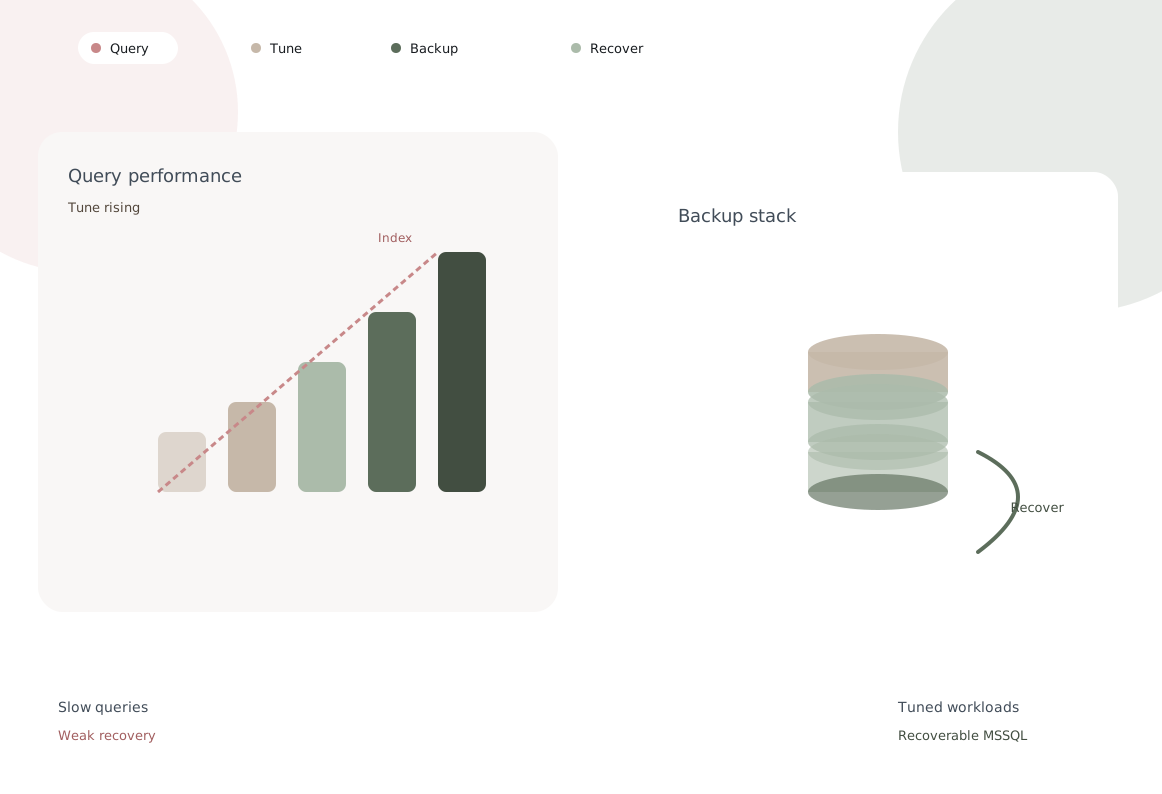
| Performance & monitoring | Tuning, maintenance, and observability practices | 3 |
| Backup, recovery & HA concepts | Recovery drills and risk-aware operations | 3 |
Delivery
Live online across roughly four weeks (~20 programme days) for about 40 delegates spanning regions. Delivery mixed demos, assessments, peer collaboration, and targeted 1:1 sessions. Simulated environments replaced scarce production-like systems. Regular feedback loops adjusted pace for beginners versus advanced practitioners.
Results
- Overall programme rating of 9 out of 10 from delegates
- Delegates reported stronger confidence using MSSQL in production contexts
- Teams improved performance-tuning and maintenance workflow practices
Plan a similar programme
Talk through your stack, cohort, and outcomes with an Uptut expert – then map a custom training roadmap for your team.
Book a free consultationClient impact
- Stronger database performance and administration capability on client systems
- Better backup, recovery, and risk-management awareness across engineering roles
- More consistent SQL practices between DBAs, developers, and operations
Proof
The Labs and mentoring finally connected MSSQL theory to the financial systems we support every day.
Database engineer, technology consulting
Trainer
Trainer details bind in Designer to the trainer reference.
Related programmes
Related courses and consulting bind in Designer to multi-reference fields.
Frequently Asked Questions
Can this programme be adapted to our stack?
Yes. MSSQL Labs can emphasise administration, T-SQL development, or performance work depending on your mix of DBAs and engineers. We also align examples to financial-application patterns when that is the systems context.
What is the minimum and maximum cohort size?
This programme ran near 40 delegates. For live-online SQL cohorts we often split advanced and foundation tracks above ~25 seats. Practical range is roughly 10–40 with facilitators scaled to Lab load.
Live online or in-person, and how do you decide?
This engagement was live online for a multi-region technology team. In-person intensives help when Lab networks are constrained; hybrid can combine local labs with remote instruction.
What lead time do you need from brief to delivery?
A multi-week MSSQL programme typically needs two to four weeks of lead time for environment provisioning and modular syllabus design. Larger cohorts need earlier calendar locks.
Do you build custom Labs, or use standard ones?
Labs are custom and environment-aware. When production clones are unavailable we provide simulated cloud SQL instances and guided exercises rather than slide-only learning.
How is training effectiveness measured?
We review Lab completion, assessment performance, and qualitative confidence on production tasks. Satisfaction scores are supporting evidence – not a substitute for skill demonstration.
.webp)
.svg)