Challenge
An EdTech partner needed to prepare a large graduate cohort for enterprise Salesforce work without months of shadowing. The 25 learners were sharp but new to CRM platforms, Apex, and security models used on live financial-services style projects. Delays in technical onboarding were creating downstream project risk for the partner’s end clients. The brief demanded a six-week intensive that simulated real objects, flows, and user management – not a certification cram – so graduates could contribute to active workstreams quickly after the bootcamp.
Why custom
Public Salesforce courses rarely embed industry workflow context or mentorship at bootcamp intensity. We designed banking-relevant scenarios – onboarding, approvals, and customer data models – while keeping naming partner-routed. Delivery mixed live instruction with adaptive pacing, 1:1 doubt clearing, and emergency support during project Labs. That combination is what a catalogue Admin or Developer class would not have provided for a zero-to-project graduate pathway.
What we built
| Module | Focus | Labs |
|---|
| Salesforce basics & navigation | CRM concepts, org structure, and day-one productivity | 2 |
| Data modelling & security | Objects, relationships, users, and sharing basics | 3 |
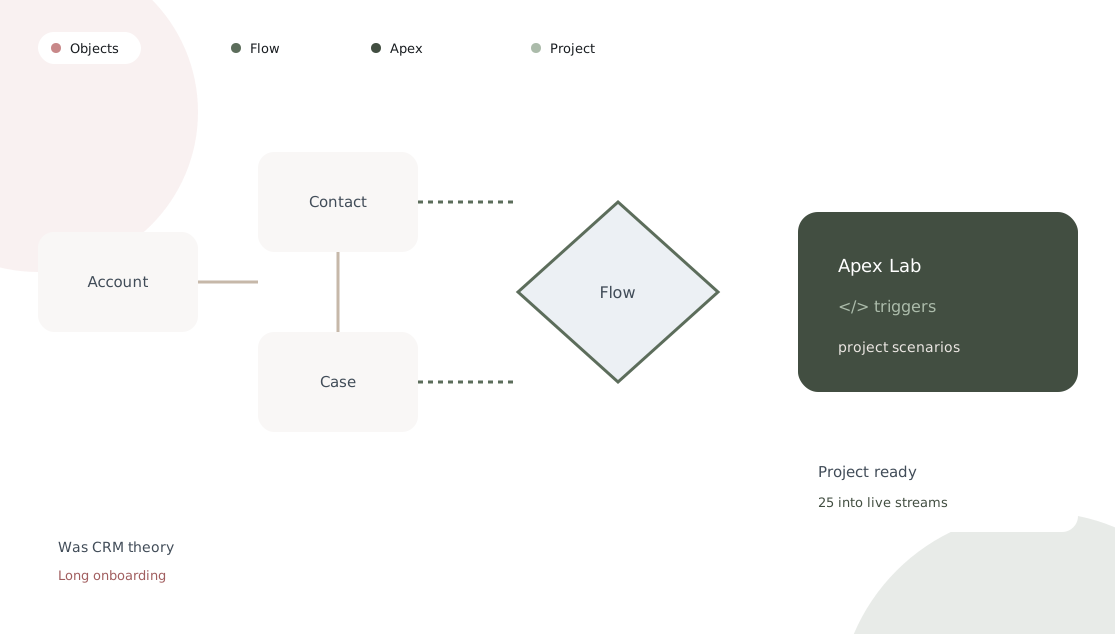
| Automation & Apex foundations | Flows, triggers, and developer fundamentals | 4 |
| Project-ready Labs | End-to-end scenarios mirroring enterprise CRM work | 3 |
Delivery
Live online over roughly six weeks (~42 programme days) for 25 graduates, led by trainer Mradula Jain. Sessions emphasised practical Labs, real-time Q&A, and mentorship. Curriculum adapted as comprehension shifted; learners practised on scenarios aligned to enterprise CRM work the partner needed. Post-training resources and help channels extended support beyond the final week.
Results
- Onboarding ramp compressed from about 3 months toward under 6 weeks
- All 25 graduates progressed into live Salesforce project workstreams
- Delegates built independent confidence with Apex, Flows, and custom objects
Plan a similar programme
Talk through your stack, cohort, and outcomes with an Uptut expert – then map a custom training roadmap for your team.
Book a free consultationClient impact
- Reduced technical onboarding delays for partner-routed graduate hires
- Improved readiness for CRM-driven project delivery
- Created a repeatable Salesforce bootcamp pattern for future EdTech cohorts
Proof
The bootcamp felt like real project work from week one – our graduates joined live Salesforce streams with far less ramp time.
Programme manager, EdTech partner
Trainer
Trainer details bind in Designer to the trainer reference.
Related programmes
Related courses and consulting bind in Designer to multi-reference fields.
Frequently Asked Questions
Can this programme be adapted to our stack?
Yes. We reshape Salesforce Labs around the objects, industries, and org patterns your partner programmes require. Banking-style onboarding and approval flows can be swapped for other CRM domains without losing the zero-to-project arc for graduates.
What is the minimum and maximum cohort size?
This bootcamp trained 25 graduates. For similar live-online Salesforce intensives we usually recommend 15–30 seats with teaching assistants above ~20. Smaller cohorts allow deeper code reviews; larger ones need stricter Lab facilitation.
Live online or in-person, and how do you decide?
This delivery was live online to reach an Americas graduate cohort efficiently. In-person intensives are an option when the partner wants campus immersion; hybrid works when some Labs need proctored environments.
What lead time do you need from brief to delivery?
Plan on three to six weeks of lead time before a six-week bootcamp – discovery, org provisioning, and scenario design. Partner-routed schedules often lock cohort dates earlier, so environment access should be confirmed first.
Do you build custom Labs, or use standard ones?
Labs are custom and project-shaped. Graduates practise Flows, Apex, and security on scenarios written for the engagement rather than generic Trailhead-only paths. Standard modules are only scaffolding.
How is training effectiveness measured?
We track Lab completion, project-readiness checkpoints, and time-to-contribution signals agreed with the partner. We do not treat attendance or “100% positive feedback” alone as proof of effectiveness.
.webp)
.svg)