.webp)
.svg)

Program overview


Online
On-site
Hybrid
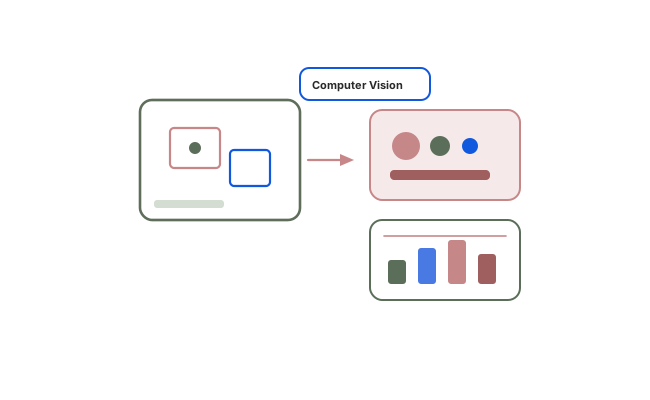
Production-Grade Computer Vision & Deep Learning
Build a strong foundation in production-grade Computer Vision systems, from model development to scalable deployment and lifecycle operations. Learn how to deliver high-performance CV pipelines with monitoring, observability, MLOps workflows, and reliability practices used in real-world enterprise environments.
Duration:
5 days
Level:
Advanced
.avif)
1500+ users onboarded
Who will Benefit from this Training?
Training Objectives
Build a high-performing, job-ready tech team.
Personalise your team’s upskilling roadmap and design a befitting, hands-on training program with Uptut

Key training modules
Comprehensive, hands-on modules designed to take you from basics to advanced concepts
Download Curriculum
- Module 1: The Production Vision Landscape
- Architecture evolution: ResNet to EfficientNet to Transformers (ViT)
- Data-centric shift: why data quality drives model performance
- Lab: Rapid Transfer Learning with TIMM to build a baseline in under 15 lines of code
- Module 2: Advanced Data Engineering
- Annotation strategy using CVAT or Label Studio
- Active learning and uncertainty sampling for labeling efficiency
- Synthetic data generation using Stable Diffusion or Copy-Paste augmentation
- Lab: Semi-automated labeling workflow with pre-trained model label suggestions in CVAT
- Module 3: Production Augmentation
- Albumentations deep dive for robust augmentation
- Domain-specific simulation: rain/fog, ISO noise, motion blur
- Lab: Build an augmentation pipeline that mimics real-world camera degradation
- Module 4: CNN Deep Dive and Debugging
- Visual debugging with Grad-CAM and activation interpretation
- Failure analysis: background bias and dataset leakage patterns
- Lab: Train ResNet50 for retail classification and debug model errors using Grad-CAM
- Module 5: Modern Object Detection (YOLOv8)
- YOLOv8 architecture: anchor-free detection, C2f modules, loss functions
- YOLOv8 vs Faster-RCNN vs RetinaNet tradeoffs
- Lab: Train YOLOv8 on a custom manufacturing defect dataset
- Module 6: The Small Object Problem
- Detecting tiny defects in high-resolution (4K) imagery
- SAHI (Slicing Aided Hyper Inference) and tiling strategies
- Lab: Implement inference tiling to detect defects missed by standard YOLO inference
- Module 7: Video Analytics and Object Tracking
- Detection vs tracking, occlusions, re-identification concepts
- Tracking algorithms: SORT, DeepSORT, ByteTrack
- Lab: Build a people counting system using YOLOv8 + ByteTrack
- Module 8: Handling Video Streams
- RTSP streams, buffering, lag, dropped frame handling
- Geofencing and counting lines using shapely and OpenCV
- Lab: Build a real-time intrusion detection pipeline on a mock video feed
- Module 9: Segmentation and SAM
- Semantic vs instance segmentation (U-Net vs Mask R-CNN)
- Segment Anything Model (SAM) for zero-shot segmentation
- Lab: Use SAM to auto-generate segmentation masks for a dataset
- Module 10: Zero-Shot Learning with CLIP
- Concept of contrastive language-image pre-training
- Natural language search use cases (catalog search without training)
- Lab: Build a natural language image search engine using CLIP
- Module 11: Vision Transformers (ViT and DETR)
- ViT architecture: patch embeddings and attention
- DETR: transformer-based end-to-end object detection
- Lab: Fine-tune a ViT using HuggingFace transformers for classification
- Module 12: OCR and Document Intelligence
- Transformer OCR intro: TrOCR, PaddleOCR
- Layout parsing for receipts/invoices using Donut concepts
- Lab: Extract structured data from shipping labels using PaddleOCR
- Module 13: Model Optimization
- Quantization: FP32 to FP16 to INT8 tradeoffs
- Pruning fundamentals
- Lab: Post-training quantization of YOLO and FPS benchmarking
- Module 14: Hardware Acceleration (TensorRT and ONNX)
- Understanding ONNX computational graphs
- TensorRT optimizations: fusion and kernel tuning
- Lab: Convert PyTorch model to ONNX and build a TensorRT engine
- Module 15: Enterprise Serving (Triton)
- Limitations of simple API serving for production concurrency
- Triton server setup, dynamic batching, multi-model execution
- Lab: Deploy TensorRT model on Triton and query via gRPC
- Module 16: Edge Deployment (Jetson and DeepStream)
- Edge constraints: thermal, memory, resource limits
- DeepStream SDK intro and GStreamer pipeline concepts
- Lab: Simulate an edge deployment workflow using remote container deployment
- Module 17: CV MLOps
- Data versioning with DVC for large image datasets
- Experiment tracking with MLflow
- Lab: Create a reproducible DVC + MLflow training workflow
- Module 18: Monitoring and Observability
- Embedding drift vs pixel drift concepts
- Outlier detection using Deepchecks or Alibi Detect
- Lab: Implement an anomaly alert pipeline for out-of-distribution images
- Module 19: Capstone Project (Choose One)
- End-to-end pipeline: Data pipeline to training to optimization to deployment
- Option A: Manufacturing visual inspection (YOLOv8 + SAHI + TensorRT + drift detection)
- Option B: Retail smart shelf (detection + CLIP + Triton serving)
- Option C: Security perimeter breach (YOLOv8 + ByteTrack + geofencing + video streams)
Hands-on Experience with Tools
Training Delivery Format
Flexible, comprehensive training designed to fit your schedule and learning preferences

Opt-in Certifications
AWS, Scrum.org, DASA & more
.avif)
100% Live
on-site/online training
.avif)
Hands-on
Labs and capstone projects
.avif)
Lifetime Access
to training material and sessions
Skill-Gap Assessment
Analysing skill gap and assessing business requirements to craft a unique program
1
Personalisation
Customising curriculum and projects to prepare your team for challenges within your industry
2
Implementation
Supplementing training with consulting support to ensure implementation in real projects
3
Why this course
- Reduce operational costs: Automate inspection, monitoring, and compliance workflows with reliable CV pipelines.
- Improve quality and safety: Detect defects, anomalies, and security breaches faster than manual methods.
- Faster AI adoption: Use transfer learning and foundation models (SAM, CLIP) to deliver results with less data.
- Production readiness: Deploy optimized, observable CV systems with real-time performance at scale.
- Future-proof capability: Build internal expertise across modern CV stacks, Transformers, and deployment acceleration.
Training objectives
- Engineer datasets using data-centric AI practices (annotation strategy, active learning, synthetic data) to improve model outcomes.
- Build robust training baselines using transfer learning with modern architectures and reproducible pipelines.
- Train production-ready object detection models using YOLOv8 and handle hard cases like small-object detection.
- Implement real-time video analytics with object tracking and streaming pipeline reliability patterns.
- Use foundation models (SAM, CLIP) for segmentation and zero-shot workflows with minimal training data.
- Build OCR and document intelligence solutions using transformer-based OCR approaches.
- Optimize models using quantization and acceleration techniques (ONNX, TensorRT) and measure latency/FPS improvements.
- Deploy scalable inference systems using Triton Inference Server with gRPC and dynamic batching.
- Apply CV MLOps practices including dataset versioning, experiment tracking, and production monitoring for drift/outliers.
- Deliver an end-to-end production-style capstone pipeline from data ingestion to deployment and observability.
Who will benefit
- AI/ML Engineers building production CV systems
- Data Scientists moving into real-time vision and deployment
- MLOps Engineers supporting vision workloads
- Computer Vision Engineers working on detection, tracking, and segmentation
- Platform and DevOps Engineers supporting GPU inference and serving
.avif)
Lead the Digital Landscape with Cutting-Edge Tech and In-House " Techsperts "
Discover the power of digital transformation with train-to-deliver programs from Uptut's experts. Backed by 70,000+ professionals across the world's leading tech innovators.
.svg)
.svg)
.svg)
.svg)
.svg)
Recommended Training
Continue your learning journey with these hand-picked courses and bundles
Frequently Asked Questions
2. Will my team get any practical experience with this training?

.svg)
With our focus on experiential learning, we have made the training as hands-on as possible with assignments, quizzes and capstone projects, and a lab where trainees will learn by doing tasks live.
3. What is your mode of delivery - online or on-site?
We conduct both online and on-site training sessions. You can choose any according to the convenience of your team.
4. Will trainees get certified?
Yes, all trainees will get certificates issued by Uptut under the guidance of industry experts.
5. What do we do if we need further support after the training?
We have an incredible team of mentors that are available for consultations in case your team needs further assistance. Our experienced team of mentors is ready to guide your team and resolve their queries to utilize the training in the best possible way. Just book a consultation to get support.