Challenge
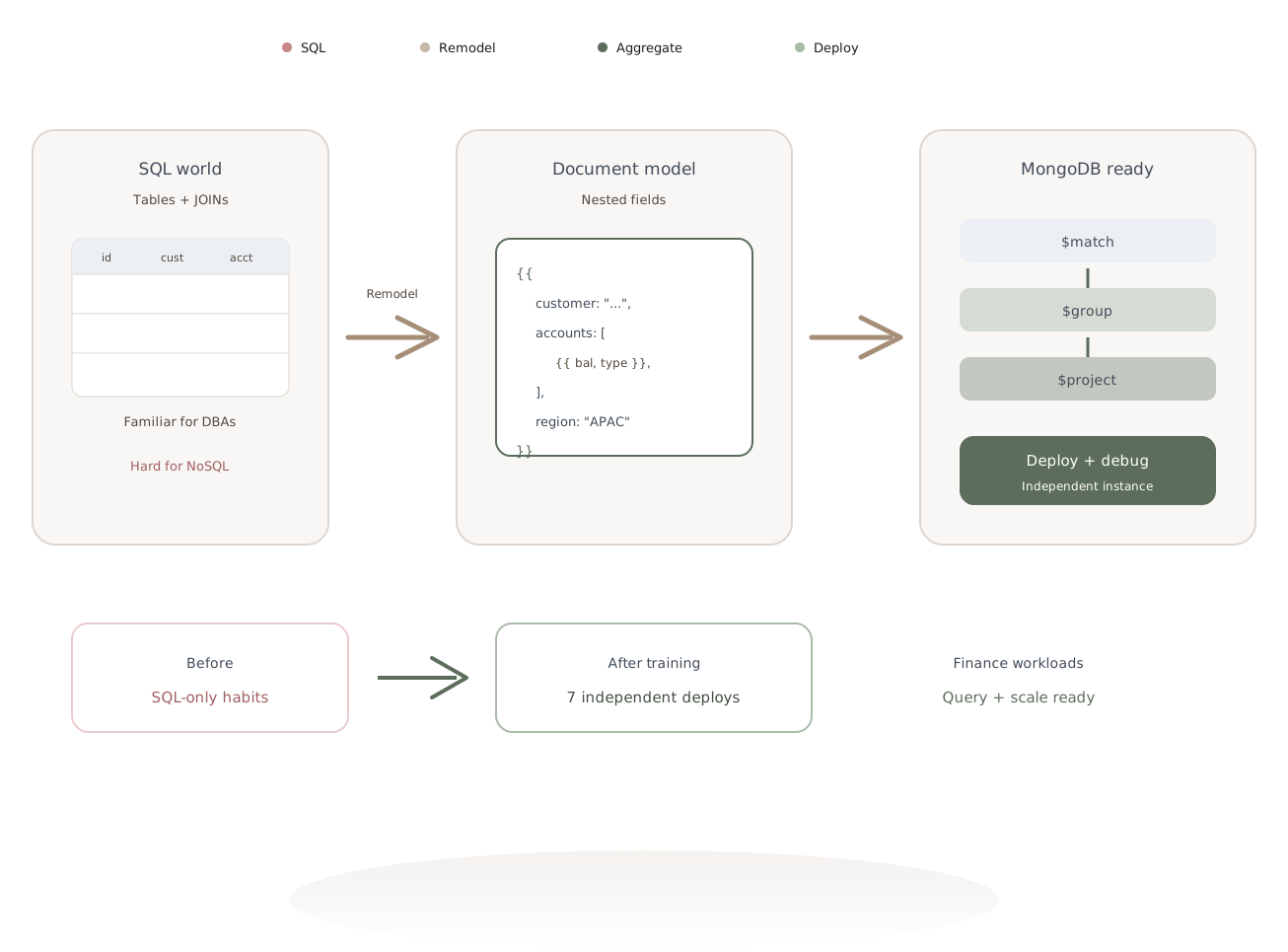
A Singapore-based financial services firm needed its DBA team to support upcoming MongoDB workloads across the Asia region. The seven specialists were strong on relational systems but lacked NoSQL foundations – document modelling, aggregation pipelines, and horizontal scaling all felt foreign. Project timelines left little room for a long academy-style course. Leadership required a short, onsite intervention that respected their SQL instincts while forcing hands-on deployment practice. Without that bridge, new document-database projects would stall behind a skills gap the organisation could not hire away in time.
Why custom
Generic MongoDB introductions ignore the SQL muscle memory of seasoned DBAs. We taught document models in parallel with relational equivalents, used finance-flavoured datasets, and made every module end in a Lab. The format was intensive onsite coaching rather than lecture theatre – so troubleshooting happened live. That SQL-to-document translation layer is what an off-the-shelf syllabus would have skipped.
What we built
| Module | Focus | Labs |
|---|
| NoSQL foundations for SQL minds | Document models vs tables; when MongoDB fits finance workloads | 1 |
| Deployment & operations | Install, configure, and operate MongoDB instances | 2 |
| Query & aggregation | CRUD patterns and aggregation vs familiar SQL joins | 2 |
| Scaling & troubleshooting Labs | Horizontal scaling concepts and independent debug challenges | 2 |
Delivery
Two onsite days for seven DBAs in Singapore. Pedagogy compared SQL structures to document models continuously. Each delegate ran deployment Labs and finished with an independent deploy-and-troubleshoot challenge. Post-training documentation and trainer follow-up covered the transition into live NoSQL work.
Results
- All 7 delegates independently deployed and debugged MongoDB instances
- Every Lab in the two-day programme completed successfully by the cohort
- Team ready to take on Asia-region MongoDB project workloads after training
Plan a similar programme
Talk through your stack, cohort, and outcomes with an Uptut expert – then map a custom training roadmap for your team.
Book a free consultationClient impact
- Enabled the organisation to accept MongoDB-based project work
- Shortened the SQL-to-NoSQL ramp for experienced DBAs
- Reduced dependency risk on scarce external NoSQL specialists for early deployments
Proof
Comparing MongoDB side by side with SQL finally clicked – by the final Lab I could deploy and debug on my own.
Senior database administrator
Trainer
Trainer details bind in Designer to the trainer reference.
Related programmes
Related courses and consulting bind in Designer to multi-reference fields.
Frequently Asked Questions
Can this programme be adapted to our stack?
Yes. We rebuild MongoDB Labs around your deployment topology, security baselines, and the SQL systems your DBAs already know. Finance-specific collections and query patterns can replace generic sample datasets so practice transfers to project work immediately.
What is the minimum and maximum cohort size?
This engagement trained 7 DBAs. For intensive onsite MongoDB transitions we recommend 4–10 delegates so every person completes deployment Labs with coaching. Larger groups need additional facilitators or a longer schedule.
Live online or in-person, and how do you decide?
This programme was in-person to maximise coaching during installs and troubleshooting. Live online works when secure Lab environments can be provisioned remotely; for first-time MongoDB deployments we still prefer onsite when possible.
What lead time do you need from brief to delivery?
A two-day custom MongoDB programme typically needs one to three weeks of lead time for discovery, environment prep, and SQL-to-document Lab design. Faster starts are possible when VPN and Lab hosts are already approved.
Do you build custom Labs, or use standard ones?
Labs are custom. Delegates deploy real MongoDB instances and work finance-relevant scenarios rather than watching standard demos. We keep optional self-study packs after delivery, but core Labs are written for your stack.
How is training effectiveness measured?
We measure independent deployment success, Lab completion, and whether delegates can troubleshoot without step-by-step prompts. Attendance is never treated as an outcome metric.
.webp)
.svg)